
Water Pressure Services in Seattle, WA
Pressure-Reducing Valves, Gauge Readings and Expansion Tanks
Lighthouse Plumbing tests and corrects water pressure in Seattle homes. Most calls come down to the pressure-reducing valve on the incoming main, which fails in both directions: it can let street pressure climb past the 80 psi the code allows, or clamp a house down to a weak 50 psi. We gauge first, then replace or reset the valve.
Recent Water Pressure Work in Seattle
Both of our photographed Seattle regulator jobs this year were within a few blocks of the Alaska Junction in West Seattle, and both were failures in the quiet direction: low pressure rather than high.
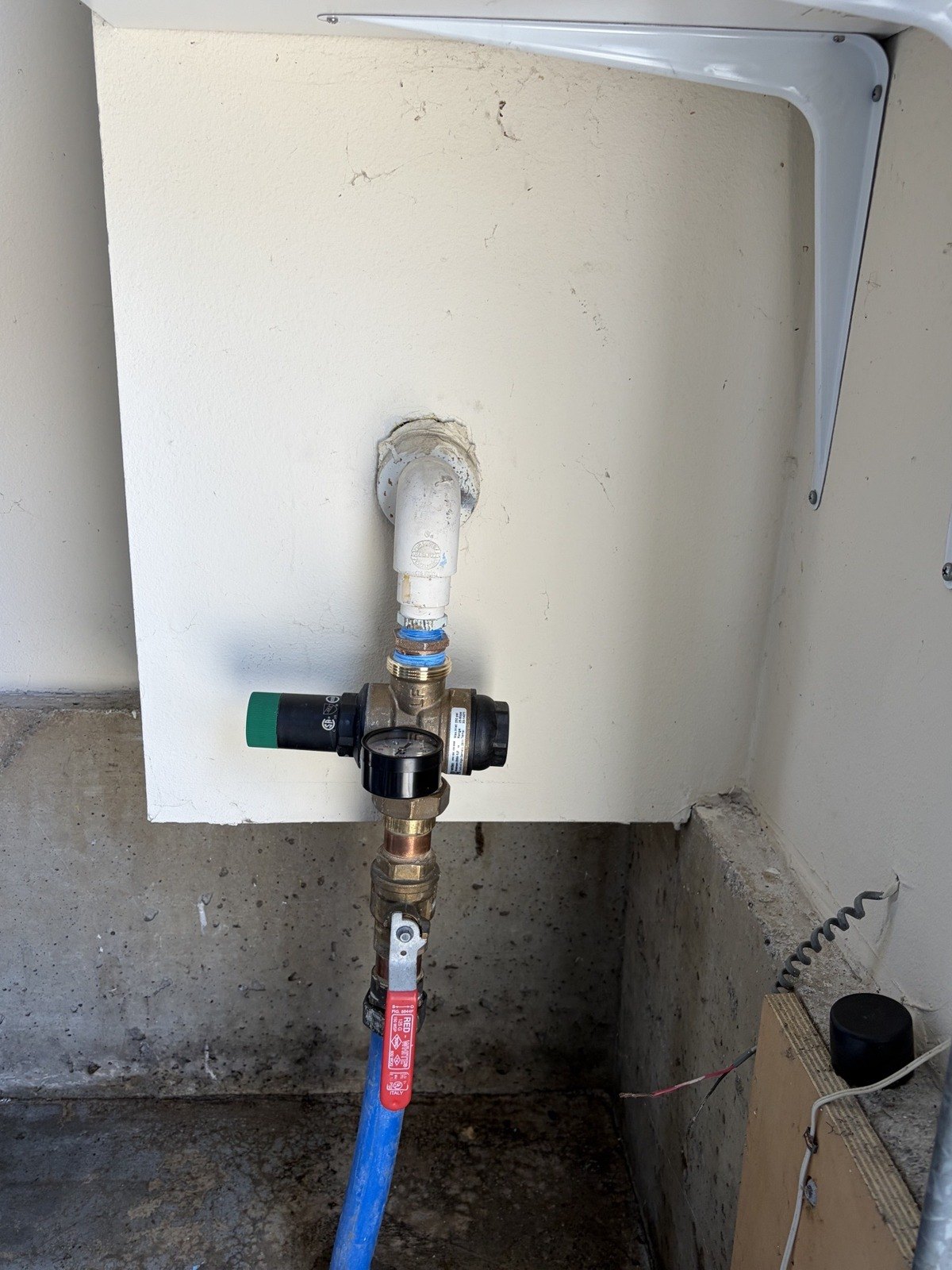
In August a homeowner booked us for weak water pressure and a toilet that would not stop running. Bradyn found the pressure-reducing valve on the 1-inch main inside the garage had failed and was holding the whole house at about 50 psi. He replaced it with a new 1-inch PRV, set it to 65 psi and read the gauge several times before he left. No leaks, one visit.
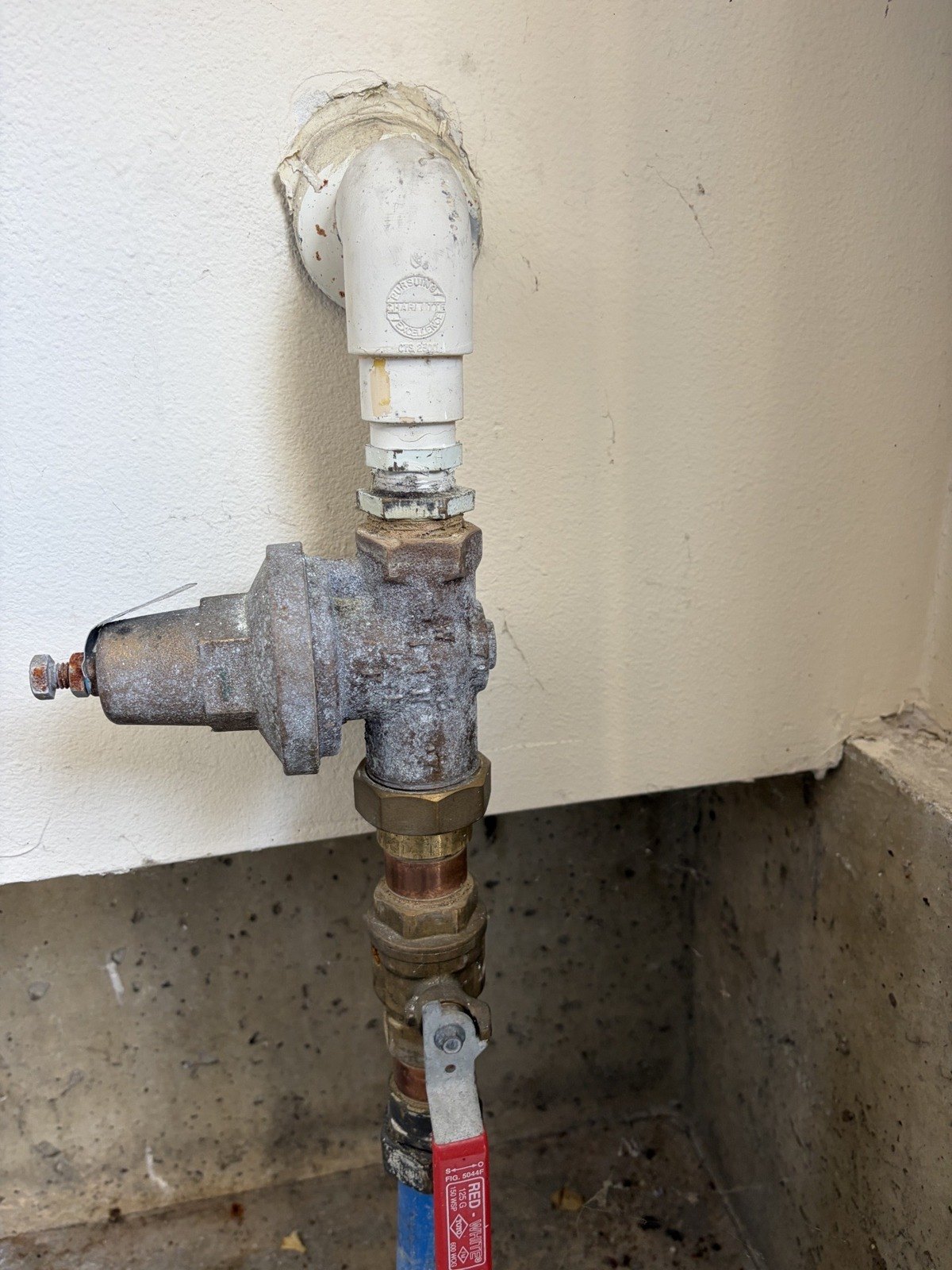
In June, a few blocks away, the regulator had failed too, and the homeowner had already bought a replacement. The new valve did not match the old one's dimensions, so Bradyn reworked the copper inside the wall access to fit it and put the house back in service. Our one-year warranty covers his work; a customer-supplied valve is warranted by its maker rather than by us, which is the trade-off of buying your own part.
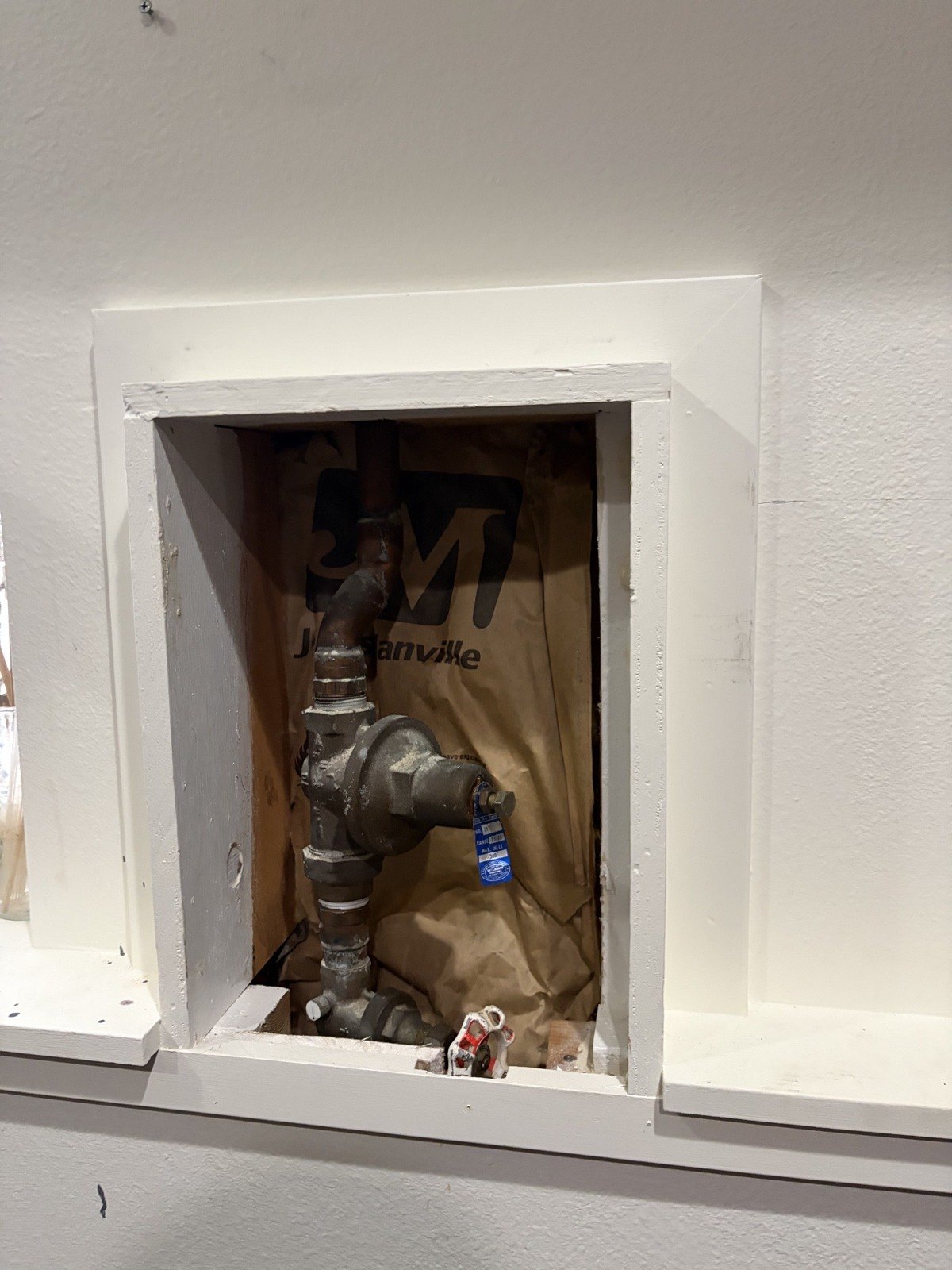
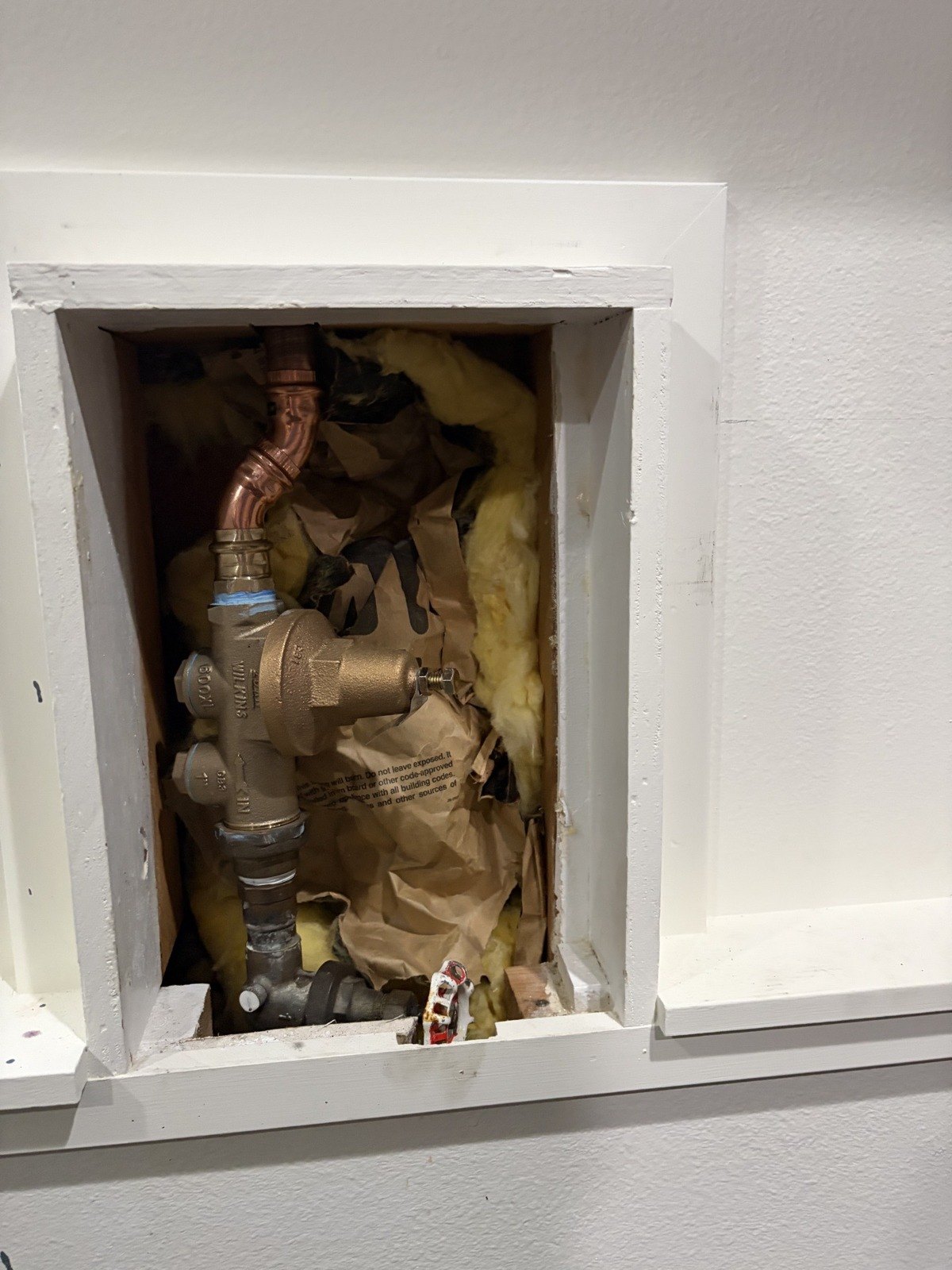
Elsewhere in the city this year: in Whittier Heights in late October, Alex installed a regulator at a house whose shower temperature had been swinging every couple of minutes; in October a Seattle property gauged at 130 psi was quoted a regulator and a new main shutoff to bring it inside code; and in Wedgwood in August, Caleb replaced a main water service, about 130 feet from the meter to the house by directional boring, with a new 1-inch main shutoff where the new line enters the house and a regulator if the incoming pressure called for one.
What We Test and Fix
Pressure testing
A gauge threaded onto a hose bib or the laundry box, read with the house quiet and again with water running. A reading that climbs overnight means the regulator is letting go.
Pressure-reducing valve replacement
A regulator is a wear part: its spring, diaphragm and seat age, and the house either creeps up or sags down. We replace it with the same size, usually 3/4 inch or 1 inch on a Seattle house, and set it to 60 to 70 psi.
Pressure-reducing valve installation
Where a house has none and the street pressure runs above 80 psi, we cut a regulator into the incoming line with a shutoff ahead of it, and add an expansion tank at the water heater, because a regulated system has nowhere to put the water that expands when the heater fires.
Expansion tanks
A water heater relief valve that drips after every heating cycle is usually a failed expansion tank, not a bad relief valve. We test the tank's charge and replace it when it is waterlogged.
Low pressure and the main shutoff
Weak pressure in one fixture is that fixture. Weak pressure everywhere is the regulator, a half-closed main shutoff or a failing service line, checked in that order.
Seattle-Specific Water Pressure Considerations
The regulator is on your side of the meter
Seattle Public Utilities owns the main in the street and the meter. The line from the city's connection into the house, and everything on it, is installed and maintained by the owner, and that includes the pressure-reducing valve. SPU keeps regulating stations between its own pressure zones, but they protect the mains, not your fixtures: when one in West Seattle malfunctioned in November 2019, a handful of nearby homes briefly saw higher pressure than normal.
Hills decide the number
Seattle is served from reservoirs and tanks on its high ground, and on a gravity system elevation is pressure. A house low on a slope below a reservoir sees far more pressure than one near the top, which is why two houses a few streets apart in West Seattle, Queen Anne or Beacon Hill can read differently at the hose bib, and why we gauge every house rather than assume.
Soft water, so regulators wear rather than scale
The city's Cedar River and Tolt River supply is soft, so a Seattle regulator rarely clogs with mineral scale the way one on hard well water can. It simply wears out. Both of our West Seattle valves this year failed quietly, letting the house drift down to 50 psi rather than announcing themselves with a bang.
The code line, and who issues the permit
Washington builds on the Uniform Plumbing Code, and section 608.2 requires a regulator where static pressure exceeds 80 psi, with an expansion tank downstream of it. The Seattle property gauged at 130 psi in October is the case the code has in mind. Plumbing permits in Seattle are issued by Public Health Seattle & King County rather than the city's building department, and we tell you before we start whether your job needs one.
Our Process
1. Gauge
We read the pressure at a hose bib with the house quiet, then with water running, and note what the water heater sees.
2. Quote
You get a firm price for the regulator, the expansion tank if it needs one, and any shutoff worth replacing while the water is off. You choose.
3. Replace or install
Most regulator jobs are one visit with the water off for about an hour; the August job, gauge checks included, took a couple of hours.
4. Set and confirm
We set the house to 60 to 70 psi, run the fixtures and re-read the gauge before we leave, so you know the number your house now lives at.
Frequently Asked Questions: Seattle Water Pressure
How much does it cost to replace a pressure-reducing valve in Seattle?
On our 2026 Seattle invoices, replacing or adding a regulator on a 1-inch main ran about $1,100 to $2,000 with tax. The low end was the June job where the homeowner supplied the valve; the high end was a new 1-inch regulator installed, set and gauge-checked.
Who is responsible for the pressure-reducing valve on a Seattle house, me or SPU?
You are. Seattle Public Utilities owns the water main and the meter, and the property owner installs and maintains the line from the city's connection to the building and everything attached to it. The regulator sits on that private side, usually where the main enters the garage, the basement or a wall access, so its repair is the owner's.
Can a failed pressure-reducing valve cause low water pressure instead of high?
Yes, and both of our West Seattle jobs this year were exactly that. A regulator can stick partly closed as it wears, holding the house at 50 psi or less at every tap at once. If one fixture is weak, suspect that fixture; if the whole house is weak, suspect the regulator before the water service.
Do I need a permit to replace a pressure-reducing valve in Seattle?
Seattle's plumbing permits are issued by Public Health Seattle & King County, and its rule is that installing, relocating or changing a plumbing system needs one. Whether a like-for-like valve swap in the same spot falls inside that depends on the job, so we tell you before we start what applies to yours and handle the paperwork when it does.
Can I buy my own pressure-reducing valve and have you install it?
Yes, as the June homeowner did. Two cautions: the new valve rarely matches the old one's lay length, so expect some copper rework, and our warranty covers the installation only. A customer-supplied valve is warranted by its manufacturer, not by us, and if it fails early the labor to swap it is a second visit.
Why would a bad regulator make my shower temperature swing?
Because a shower valve balances hot against cold by pressure, and a regulator that hunts moves the cold side every few seconds. The valve chases it, and the water goes hot, cold, hot. That was the complaint at the Whittier Heights house in October, and the work order was a regulator on the main, not a shower valve.
Serving Seattle from Fall City
We work in Seattle most weeks, from West Seattle and Beacon Hill to Ballard, Wedgwood and Lake City, and a regulator job is a single visit in a Seattle day. Our Eastside and valley pressure work runs the same way, from Issaquah to Fall City, where our shop is.
More about our Seattle service area · Back to water pressure services
Why Seattle Homeowners Choose Lighthouse for Pressure Work
We read the gauge before we sell a part
Low pressure can be a regulator, a shutoff or a service line. Ten minutes with a gauge tells us which, and in West Seattle this year it was the regulator both times.
We fix the pair, not the part
A regulator without a working expansion tank sends the problem to the water heater. When one is due, we check the other while the water is off.
We tell you what the number is
Every job ends with a reading you can write down, so the next time the shower feels different you know what changed.
Licensed, Bonded & Insured
Lighthouse Plumbing is a fully licensed, bonded and insured Washington plumbing contractor. Our license number is LIGHTP*762K2, and you're welcome to verify it with Washington State L&I before we start. More detail is on our licensing and insurance page.