
Rain does not break a sewer line. It finds the one that is already broken, bellied or full of roots, and it fills the public pipes until a borderline line has nowhere to drain. Here are the six ways a storm turns into a backup, with what we found in the lines this year, and what fixes each one.
1. Rainwater gets into the sewer pipes
Sanitary sewers are meant to carry only what comes from inside houses, but groundwater seeps in through cracked pipes and joints, and surface water pours in through broken cleanout caps, low manholes and gutters that were tied into the sewer decades ago. King County, which treats the Eastside's wastewater, estimates that more than a quarter of what its plants handle in a year is this rain and groundwater, not sewage. When a storm fills the main past capacity, the water in your side sewer has nowhere to go, and the lowest fixture in the house is where it shows up.
2. In Seattle, the rain and the sewage share one pipe
About two-thirds of Seattle is served by combined sewers that carry stormwater and sewage together, and in heavy rain that system can be overwhelmed. The city's relief is to overflow at outfalls into Puget Sound and the lakes rather than into basements, but a basement below the level of the street main is still the next lowest point. Seattle Public Utilities will consider paying for a backwater valve where its staff confirm that the city system caused the backup and that the cause was a lack of capacity during a storm. Our backwater valve answers explain the valve and that policy.
3. Saturated ground finds the cracks and the roots
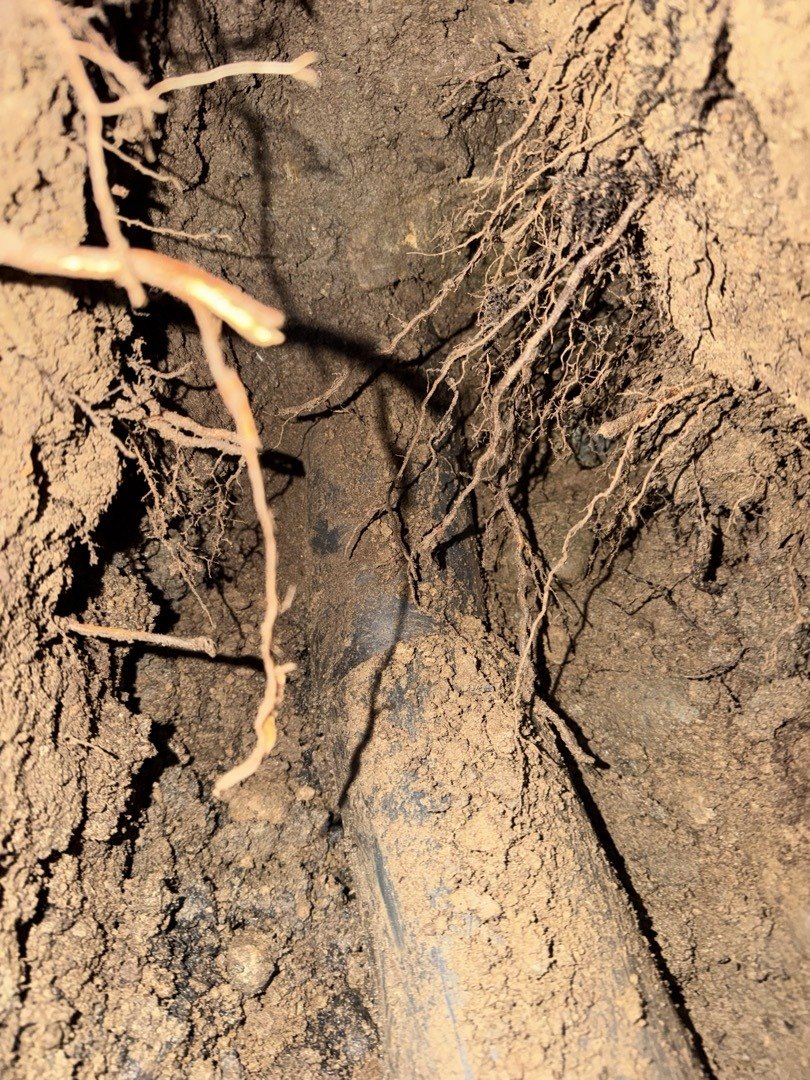
Roots grow toward water, and a sewer joint that weeps is water all summer. By the time the ground is saturated in November, the root mass that has been quietly narrowing the pipe becomes a dam. East of Redmond in October, the camera found a line snapped and separated five feet from the septic tank, in ground thick with roots; in Rainier View in Seattle, roots had worked into the joint where the cast iron from the house met the old concrete side sewer. In Mountlake Terrace in July, a backup traced to channel rot in an old concrete sewer, the floor of the pipe eaten away. None of those lines broke in the rain. The rain is when they stopped keeping up.
4. Bellies and low spots hold water all year
A section of pipe that has settled out of grade holds a puddle in its bottom even when the line is clear. Solids drop out in the puddle, the opening shrinks, and a heavy rain or a long shower is the last straw. In Issaquah in October we corrected a drain that had bowed out of level, the cause of recurring backups in the house, and near Lake Marcel outside Carnation the line to a septic tank had settled into a slope that ran the wrong way. A camera after a backup is how you find a belly; cabling through it only buys time.
5. On septic, the drainfield is the pipe that fills
A septic drainfield works by soaking wastewater into the soil, and in a wet valley winter the water table rises to meet it. When the field cannot take water, the tank fills, and the house backs up into its lowest drain. In Fall City in September, a backup pushed sewage into the home's secondary drain lines before the tank was pumped and the lines were jetted, and in July another Fall City house had its line cleared and its toilet reset the same day the tank was pumped. Our well and septic guide covers the habits that keep a drainfield alive.
6. Downspouts, yard drains and footing drains tied into the wrong pipe
A roof delivers a remarkable volume of water in a storm, and when a downspout or a footing drain was connected to the sanitary sewer, that volume arrives at your side sewer at the worst possible moment. Sometimes it is the storm side that fails instead, with gutter drains and yard drains backing up and pooling at the foundation. If your sewer backs up only when it rains and the camera finds the pipe sound, look at what the gutters and the yard drains are connected to.
What to do when it backs up during a storm
Stop running water, and do not run the washing machine or the dishwasher until the drains recover. Find the outside cleanout: if sewage is standing in it, the problem is downstream of the house, in your line or the main; if it is dry, the blockage is inside. Call, and when the line is cleared, have it scoped while it is empty, because the storm only showed you where the weak spot is.
Rainy-Day Sewer Questions
Is a sewer backup during a storm the city's responsibility?
Usually not. In Seattle, Kirkland and Redmond the side sewer is yours to the public main, and a backup caused by your own line is yours to fix. Seattle Public Utilities may fund a backwater valve when its staff confirm the city system caused the backup through a lack of storm capacity; the Eastside cities maintain their own mains.
Can I prevent rain-related backups without digging up the sewer?
Often. Clearing roots with a jetter and a camera buys years on a line that is otherwise sound, disconnecting a downspout from the sewer removes the storm surge, and a backwater valve protects a low basement from the main. A belly or a separated joint, on the other hand, is a dig, and the camera tells you which you have.
Why do my drains gurgle when it rains hard?
Because the main is running full and the air in your side sewer has to go somewhere. As water rises in the public pipe it pushes air back up your line, and that air bubbles through the nearest trap, a floor drain, a tub or a toilet. Gurgling in a storm is a warning that the main is near capacity.
Our Recommendation
If your sewer has backed up in a storm once, have the line scoped before the next one. The camera will show one of four things: roots at a joint, a belly, a break, or a sound pipe that is simply downstream of an overloaded main. The first three have repairs with prices we can quote from the video, and our sewer cost answers give the 2026 ranges. The fourth is a backwater valve conversation, and in Seattle, possibly one the utility helps pay for. On septic, the first call is to have the tank pumped and the drainfield looked at, and the second is to us for the line between the house and the tank.
Get the Line Scoped Before the Next Storm
Call 425-549-2400 or schedule an appointment.
More: sewer line repair in Seattle · sewer line repair in Fall City · a sewer line snapped at the septic tank east of Redmond · should you get a sewer scope before you buy? · drain cleaning