
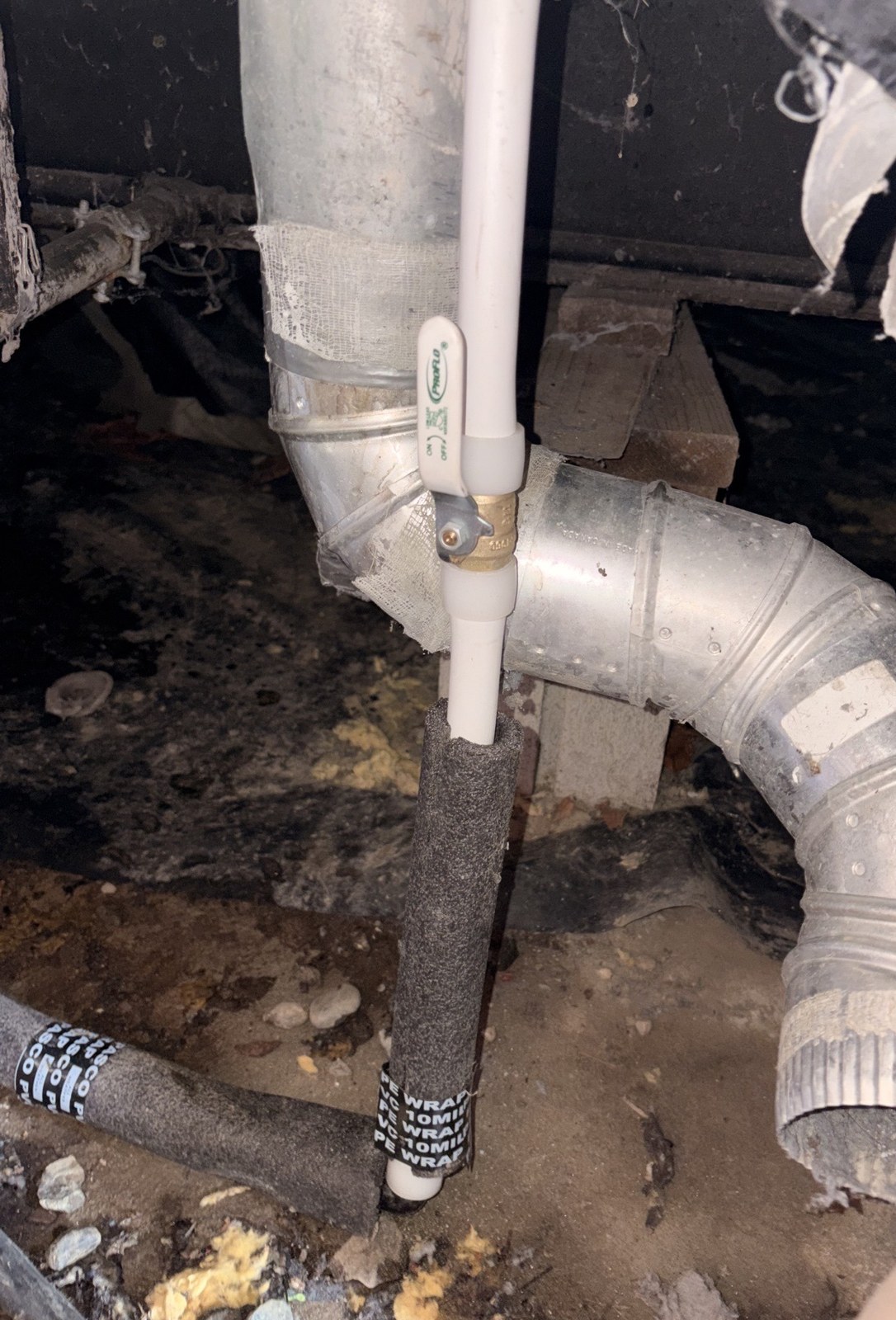
Valley houses freeze in predictable places: the hose bib with a hose still on it, the pump house, the crawlspace run near a vent, the garage and the patio line nobody drained. Fix those places before the first clear cold night and most of the valley's burst-pipe calls never happen. Here is the list, with the jobs behind each item.
The Snoqualmie Valley floor pools cold air on clear nights, so Carnation, Fall City and Duvall regularly wake up several degrees colder than Seattle, and the houses out here have more pipe in cold places: crawlspaces, pump houses, garages and additions. The usual rule of thumb is that pipes in unheated spaces are at risk once the outside temperature stays around 20°F or below, which the valley sees most winters and Seattle often does not.
1. Take the hoses off, then look at what froze last year
A frost-free hose bib only protects itself if the hose is off, because a hose traps water in the spout. The split happens inside the wall and shows itself in spring: in May we replaced a Fall City bib that had frozen and cracked over the winter, at a house where the bib had not been covered, and another Fall City bib on an uninsulated exterior wall where we could not warrant against the next freeze. If a bib dripped or sprayed behind the wall when you first used it this year, it froze last winter. Replace it now, not in April. Our hose bib page covers what goes in its place.
2. Protect the pump house and the pressure tank
On a well, the most exposed plumbing on the property is in the pump house or the well shed: the pressure tank, the pressure switch, the lines in and out, often in an uninsulated box with a gap under the door. When that freezes, the whole house goes dry, and the first call on a cold morning is to a plumber for what is really a frozen shed. Insulate the walls, seal the door, and put a thermostat-controlled heat source rated for the space inside before December. Our well and septic guide covers the pump side in detail.
3. Walk the crawlspace with a flashlight
Supply lines in a crawlspace freeze where cold air moves: beside a foundation vent, under a missing piece of insulation, where a pipe runs along a rim joist. Close or cover the vents during a hard freeze, put the fallen insulation back over the pipes, and look hard at any CPVC. Many valley houses were plumbed in it, and cold makes brittle pipe worse: our Duvall leak page tells the story of CPVC fittings that cracked in summer, and winter is not kinder.
4. Mind the garage and the additions
A water heater in a garage, as many valley water heaters are, sits in the coldest room in the house, and the supply lines above it are the first to freeze when the door is left open. Keep the garage door shut in a freeze, insulate the exposed lines, and do the same for any plumbing in a room added onto the house over a crawlspace or a slab, where the insulation under it is often thin.
5. Drain the outdoor kitchen, the patio line and the irrigation
Any line that runs outside the heated envelope needs a shutoff inside and a way to drain. In Duvall in June we added winterization valves on the lines serving a patio while we were replacing the house's regulator and a hose bib, so the homeowner can close and drain them each fall. In Seattle in October, Beau set up a homeowner's new heavy-duty hose bibs the same way, with the supply arranged to be isolated for the winter. If your outdoor line has no inside valve, adding one is a small job in November and a flood in January.
6. Know what to do when the house wakes up dry
No water at any tap on a freezing morning means one of two things: on a well, a frozen pump house or a tripped pressure switch; on district or city water, a frozen section of pipe, usually in the crawlspace or an exterior wall. One cold tap in one room is a frozen branch line. Open the affected faucet, warm the space with a space heater or a hair dryer on the pipe, and never use a torch. If a section thaws and starts to spray, that is the burst, and the main shutoff is the next move.
7. Have the main shutoff ready before you need it
Every item above fails safe if the water can be shut off in a minute. Find the main, confirm it turns, and replace a seized gate valve with a quarter-turn ball valve while nothing is wrong. Our fall checklist walks through it. When a pipe does burst, shut the main, open a low faucet to drain the pressure, and call. A repair on old CPVC is a stopgap, and we will tell you so when we make it.
Frozen Pipe Questions
Which pipes freeze first in a Snoqualmie Valley house?
The hose bib with a hose left on it, then the pump house or well shed, then any supply line in a crawlspace beside a foundation vent or along a rim joist. Garage water heater lines and plumbing in additions come next. Interior walls on a heated house almost never freeze; the trouble is always at the edges.
Should I leave a faucet dripping on freezing nights?
On district or city water, a slow drip from the faucet farthest from the main keeps water moving through the most exposed run and is cheap insurance on the coldest nights. On a well, think twice: a drip cycles the pump and can run a shallow well down. Insulate the vulnerable run instead and warm the pump house.
Is it safe to leave heat tape plugged in all winter?
Thermostat-controlled heat cable that is listed for the purpose and installed to its instructions, yes. It only draws power when the pipe is near freezing. Old unregulated tape, tape wrapped over itself, or tape under insulation it was not rated for is a fire risk. Replace it rather than trust it.
Our well house froze and we have no water. What do we do?
Shut off the breaker to the pump, warm the pump house slowly with a space heater, and watch the pressure tank and the switch for cracks or leaks as they thaw. Once water is back, check that the switch cycles normally. If the pump does not restart or the tank has split, call us, and insulate the shed afterward.
Our Recommendation
Do items 1, 5 and 7 this weekend: hoses off, outdoor lines drained, main shutoff found and turned. If you are on a well, item 2 is the one that keeps the house running, so insulate and heat the pump house before the first clear cold spell. Then spend half an hour under the house with a flashlight for item 3. If you find CPVC near a vent, a frozen bib from last year, or a main that will not turn, that is one visit for us, and it is cheaper in November than at six in the morning in January.
Get the Cold Spots Fixed Before the Freeze
Call 425-549-2400 or schedule an appointment.
More: hose bib replacement · leak detection and repair · why valley homes need different plumbing · Snoqualmie Valley plumbing questions · plumbing in Fall City